I get asked by a lot of new product managers how to develop "product taste". It seems like product taste has been a hot topic lately as many think that, with AI, writing code is no longer a bottleneck and taste is the last true differentiator. To be honest, I don't really agree with that. Not every product that is developed with great taste is successful and not every successful product is tastefully developed. Salesforce is not a tastefully developed product yet it's obviously successful.
To me, developing a product with taste is about taking pride in the product that you create. And it has some very real benefits. In a highly competitive market, when a user can feel the care and effort that you have put into the product, it can can make a difference.
Product taste isn't just one thing. It's honestly more of an art than a science. It's a combination of UX, design, feature set, typography, the way it makes you feel when you use it, and the promise that it holds. It hides the trade-offs that the developers had to make while accentuating the care and love that was put into it's development. To me, products that are developed with good product taste can anticipate my needs without ever meeting me and present me with resources without being overwhelming. They balance design and utility, merging both into a form factor that is pleasant to look at and use.
Product taste is made in the details. In the design and development decisions that engineering teams make ever day. Should this button route to another page or can we should we have a drawer that slides out? Should this accordian ease-out when it expands or just instantly expands? Should the user be able to do A and B on one page or should that be split out into two pages? Should we ship v0 of this feature today or polish it and ship it next week?
The sum of the decisions build the case of whether or not you have taste and the users are the judges.
If you're a young product manager or developer, I think the most important thing is to become a student of the game. You can't develop good taste if you're not actvely researching and analyzing products. You should be able to talk at length about products that you love and specifically why you love them.
Just like a food critic goes to a restaurant and evaluates every single aspect of the meal experience from beginning to end, a product manager with good taste will do the same for the product experience. In doing so, you start to pick up on the little details that turns a 9/10 product experience to a 10/10. Are the buttons rounded to the same pixel size? Do they have a consistent hover state? Why does the user have to click an extra button to do this thing instead of just doing it on the page directly? Why is the product so slow? Why does the user have to highlight and copy and paste an API key instead of just clicking a button that adds it to their clipboard automatically?
One way to start to develop that taste is to look at products that are generally seen as being built with taste. Specifically, in B2B, it's products like Stripe, Supabase, and Linear.
Let's look at Stripe as an example.
Stripe is arguably most famous for it's developer experience and documentation.
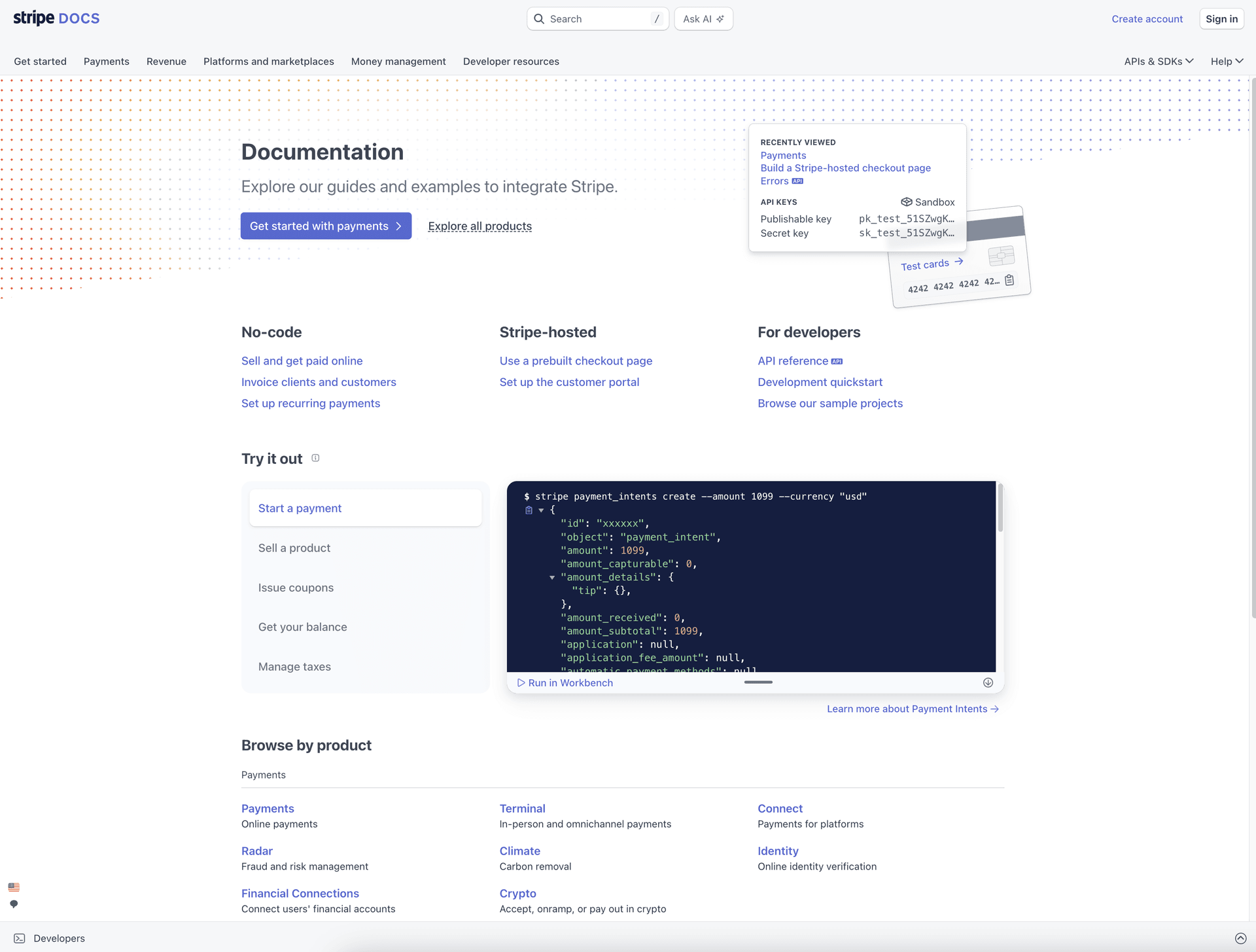
When you go to their documentation site (above), your eyes are immediately taken to the highest contrast section on the page which is the "Try it out" code block. Right away, you can see an code example of starting a payment. Most companies would have a buttont hat takes you to another page. But Stripe takes it a step further. If you click on the "Run in Workbench" button, you can actually run a request and see the response without ever leaving the page. There's no page reload, you don't get taken to an API reference page where you have to fiddle with an auth token, it happens right then and there.
Like I said, tastefully designed products can anticipate your needs. When you read a code block, the next thing you want to do is try it. Giving the user an easy way to send a sample request without any navigation or interruption in the workflow is how product taste manifests itself.
Here's another example that I love.
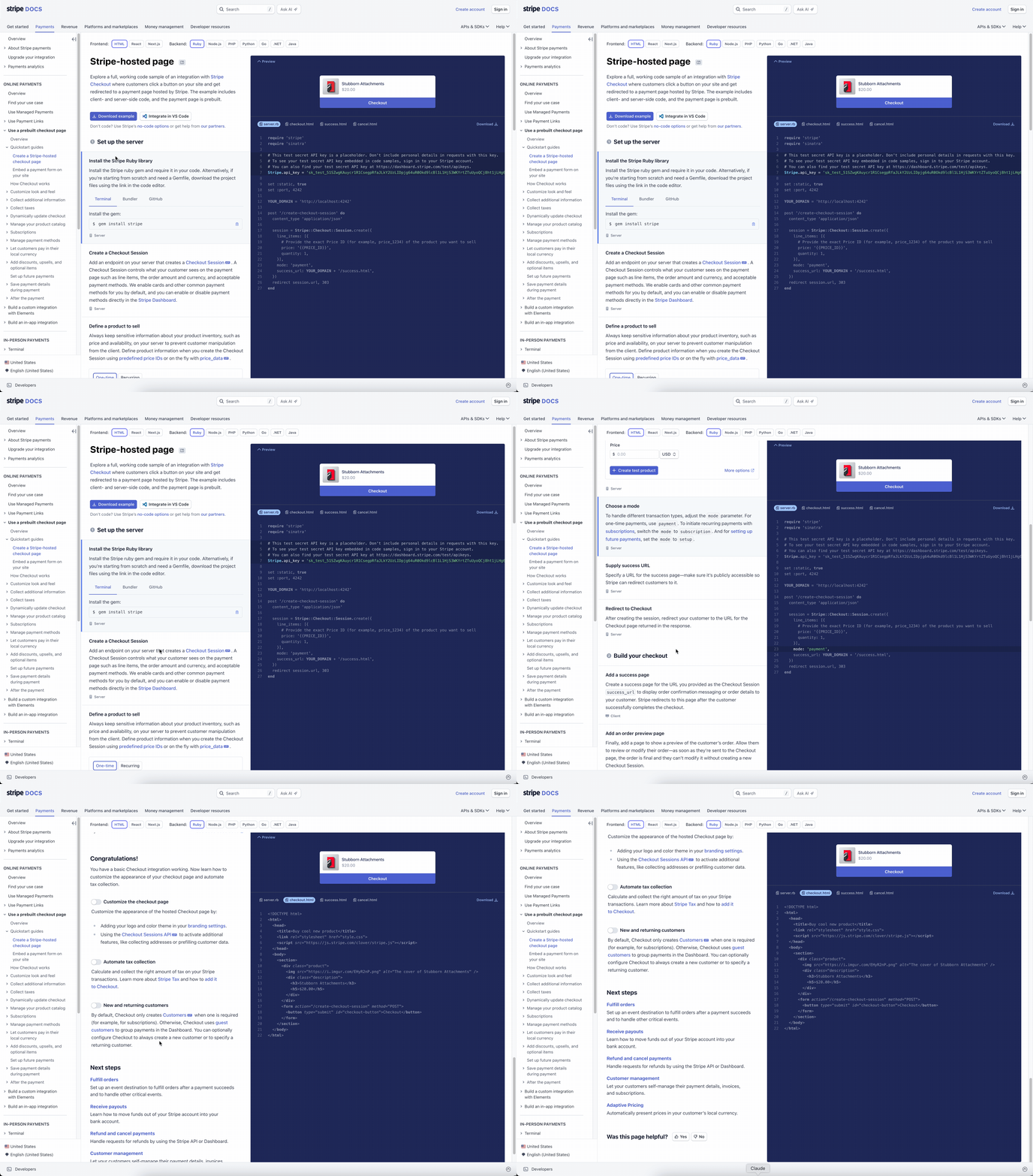
In the Stripe documentation, they have a quickstart guide showing you how to implement payments. It spans multiple files. When you start scrolling on the left hand side of the page, the right hand side code editor follows along, mapping each section in the guide to the correct lines of code so you can see exactly how the steps line up to the code. It even auto switches to the next file!
Guides are meant to help you accomplish a goal. But often times, especially in developer products, each step actually has multiple sub steps and it's not always easy to follow along. The Stripe designers in this case, were able to guide you through the entire example, code snippet by code snippet, without losing context of the entire code across multiple files.
There are so many other details that make Stripe such an exceptionally designed product and I could do the same for Supabase and Linear. When I use these products, I can feel the care, effort and love that those teams put into building those products.
I think most people can develop product taste but I think few people can actually execute on it. It's hard to execute because you have to pay granular attention to every detail of the product and then, more importantly, be willing to not compromise on those details. When you're facing deadlines and impatient founders, are you willing to push back on the the timelime or (inevitable) scope creep in order to develope a beautiful product?
It's not enough to just notice those details, you have to prioritize them.
That's product taste.